
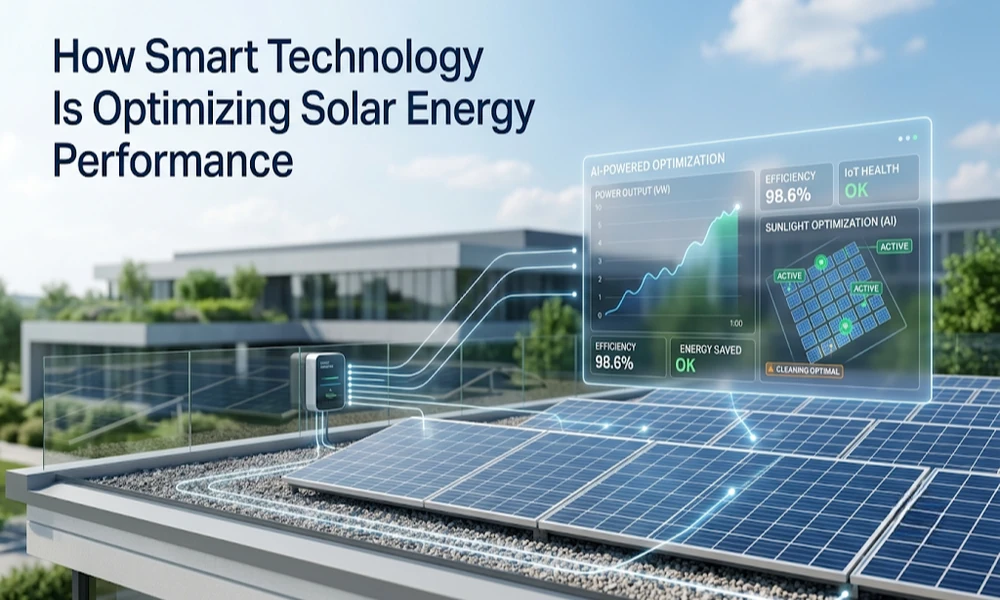

Solar in India has grown fast, and now that the country’s chasing 500 GW of renewable capacity by 2030, just having panels on your roof isn’t really the finish line anymore. How well your system performs day to day depends a lot on whether it’s being monitored properly, and that’s where smart energy management systems come into play.
What These Systems Actually Do
Put simply, these systems pair hardware with software to track how much power you’re generating and using, then make small adjustments in real time to get more out of the setup. That matters especially in India, where weather can swing dramatically depending on where you are.
On the hardware side, you’re looking at sensors that pick up performance data, weather stations tracking local conditions, and a smart meter that talks to the grid in both directions. Add in a few IoT devices, and you’ve got a system that’s watching itself pretty closely.
The software is really where things get interesting, though. AI models sift through the performance data and catch problems, like a panel underperforming, before they turn into bigger issues. Instead of just staring at numbers, you get something you can actually act on.
Why This Matters Across India
Take Rajasthan’s heat or Kerala’s humidity; both create very different challenges for a solar system, and monitoring helps you deal with either. Some studies point to efficiency gains of 15 to 20 percent just from catching things like dust buildup early, which is a bigger deal than people realize, especially in cities with more pollution in the air.
There’s also the tariff angle. A lot of state electricity boards now charge differently depending on the time of day, so being smart about when you draw power or feed it back to the grid genuinely saves money. SEMS makes that kind of scheduling almost automatic.
What’s Changed Recently
Mobile apps have changed how people interact with all this too. Checking your system’s performance or getting an alert if something’s off now happens right from your phone, no separate dashboard needed. AI has pushed this further still, adjusting load balancing and forecasting based on how you actually use energy rather than some fixed assumption.
Making It Work in Indian Conditions
None of this works well, though, if the system can’t handle Indian conditions specifically: the heat, the monsoons, the dust. Most people see their investment pay off within 12 to 18 months, along with less wasted energy and panels that simply last longer. Good local support matters here too, since even the smartest system needs someone to step in occasionally.
Waaree has built its approach around exactly these kinds of Indian conditions, offering rooftop solar solutions backed by a wide service network across the country. With over 25.8 GW in manufacturing capacity, the company continues pairing dependable hardware with practical monitoring tools, helping people get steadier, more reliable value out of their solar installations over time.
